Can You Dry Water Damage Yourself? What Works and What Doesn't
Can I dry water damage myself? Yes for small clean-water spills. Learn where fans and dehumidifiers fall short, plus carpet, hardwood and wall cavity limits.
By WDR Mississauga 12 min read
Yes, you can dry some water damage yourself. A clean-water spill on a hard floor, or a damp patch of carpet caught within a few hours, is a realistic DIY job. If you’re asking “can I dry water damage myself” after water has soaked into walls, run under flooring, or come from a toilet, floor drain or flood, the honest answer changes. Fans and a household dehumidifier dry the air and the surface. They don’t reliably dry wall cavities, subfloors or insulation, and they do nothing about contamination. Below is how to tell which side of that line you’re on, including for carpet and hardwood.
Can I dry water damage myself? A decision table
Three things settle most cases: how clean the water was, how long it’s been wet, and where it went. The table follows general restoration practice and public health guidance, and your situation may sit between two rows.
| Situation | DIY drying realistic? | What it usually takes | Get help when |
|---|---|---|---|
| Clean water (supply line, sink, rain at a window) on tile, vinyl or sealed concrete, found within hours | Yes | Mop or wet/dry vacuum, fans, a dehumidifier, 1-2 days | Water ran under baseboards or into a wall |
| Clean water soaking part of one carpeted room | Sometimes | Extraction, lifting the carpet, replacing the pad | Carpet is still damp after 24-48 hours, or a whole room is wet |
| Category 2 water (washer, dishwasher, toilet overflow without waste) | Limited | Cleaning and disinfection first, porous items often discarded | Water reached drywall, carpet pad or a finished basement |
| Category 3 water (sewage, floor drain backup, outdoor flood water) | No | Contaminated porous materials removed by people with protection | Always. Keep people and pets out |
| Water inside walls, ceilings or insulation | Not reliably | Moisture mapping, opening or venting cavities, specialist drying | As soon as you suspect it |
| Water under hardwood, laminate or a subfloor | Rarely | Floor drying systems or removal, readings over several days | Boards cup, buckle or feel soft |
| Visible mould or a musty smell that won’t clear | Only for a small patch | Assessment, and containment for larger areas | Growth larger than about 1 m² (Health Canada’s small-area limit) |
The pattern is consistent. DIY works where you can reach the water, watch the surface dry, and measure it. It stops working once water goes somewhere you can’t see.
Why the first 24 to 48 hours matter
The US Environmental Protection Agency’s brief guide to mould, moisture and your home says to dry water-damaged areas and items within 24-48 hours to prevent mould growth. Health Canada’s guide to addressing moisture and mould gives a similar window: mould can begin to grow in an area with excess moisture within 48 hours.
That window is the real test for any DIY plan: will every wet material be dry within two days? A tile floor will be. A soaked carpet pad, a wet stud bay or the underside of a hardwood floor usually won’t, even when the surface feels dry. For what happens once that window closes, see our timeline of how fast mould grows after water damage.
Water category and class, in plain terms
Restoration contractors in Canada and the US generally work from the IICRC S500, the Standard for Professional Water Damage Restoration (current edition 2021). It sorts water losses two ways.
Category describes how dirty the water is. Category 1 comes from a clean source like a supply line. Category 2 carries some contamination, such as washing machine discharge. Category 3 is grossly contaminated, which covers sewage and outdoor flood water. Clean water doesn’t stay clean, either. After a day or two in carpet or on a basement floor, restorers treat it as a higher category.
Class describes how much water there is and how hard it will be to dry. A small wet area is the easy end. Soaked walls, ceilings and subfloors are harder, and dense materials like hardwood, plaster and concrete need specialty methods. DIY drying is a fair match for low category and low class. Anything beyond that is a mismatch of tools, not a question of effort.
How to dry a small clean-water spill yourself
If your situation fits the first two rows of the table, this order of work makes sense. Safety comes first. If water is near outlets, power cords or the electrical panel, don’t walk into it, and never touch the panel while standing in water. If you can’t shut off power from a dry spot, call an electrician, or Alectra Utilities if the problem is at the meter or service.
- Stop the source. Close the fixture shut-off or the main water valve.
- Photograph the damage before you move anything, for your insurer or landlord.
- Remove standing water with a mop, towels or a wet/dry vacuum plugged into a GFCI outlet well away from the water. A regular household vacuum isn’t built for this.
- Clear the floor. Move rugs, boxes and furniture out, and put foil or plastic blocks under any legs that have to stay.
- Pull baseboards in the wet zone if water reached the wall line. This lets air reach the bottom edge of the drywall and shows whether water went further.
- Run fans across the wet surfaces and a dehumidifier in the closed room. Open windows only when the outside air is cool and dry, not on a humid summer day.
- Empty or drain the dehumidifier and confirm it’s actually collecting water.
- Check twice a day. Compare the wet area with a dry area of the same material, by touch and ideally with a moisture meter.
If the surfaces are still clearly damp after 24 hours, or readings haven’t come down toward the dry areas by 48 hours, the job is bigger than your equipment.
What fans and household dehumidifiers can and can’t do
Box fans and pedestal fans speed evaporation from things that are wet on the outside, like tile, sealed concrete and the face of a wall. They don’t push air into a wall cavity, under a floor, or through a carpet pad sitting on concrete.
A household dehumidifier lowers room humidity, which gives evaporating water somewhere to go. Its rated capacity, though, is measured under set test conditions, and a cool Ontario basement is often colder than that. Many compressor units slow down noticeably in cool rooms, and some ice up. Restoration crews tend to use low-grain refrigerant (LGR) or desiccant dehumidifiers, which are designed to keep pulling water at lower temperatures and humidity.
There’s a bigger limit than capacity. Neither a fan nor a dehumidifier tells you when something is dry. Drywall can feel dry on the face while the bottom plate, the insulation or the back of the board is still wet. Health Canada’s guide lists flooding that has reached wall or ceiling cavities among the situations where professional help is recommended. Relying on touch alone is guessing.
Fans have one more downside. Where water may be contaminated, or where mould has already started, blowing air across the surface can carry particles through the house. Don’t aim fans at Category 2 or 3 materials or at mould.
Drying wet carpet: what’s realistic
Carpet is the floor most people try to save, and with clean water caught early it sometimes can be. Most carpet is synthetic and dries reasonably well. The underpad is the problem. It’s a foam sponge sitting on a cold subfloor or slab, and air from above barely reaches it.
General practice for a clean-water carpet loss runs like this. Extract as much water as you can with a carpet extractor or a strong wet/dry vacuum, using slow, overlapping passes. Lift the carpet off the tack strip at a corner, pull out the wet pad, and float the carpet with fans blowing underneath it. Pad is inexpensive, so replacing it is usually faster and safer than trying to dry it. Check the slab or subfloor too, because concrete holds water and will feed moisture back into new pad.
Some situations turn carpet into a discard item. Health Canada’s guide advises throwing away carpets that have gotten wet in a flood, and with Category 2 or 3 water, carpet and pad are generally removed. The EPA’s water damage response table says carpet needs to be dry within 24-48 hours and notes its guidance covers clean water only. If the carpet smells sour, has been wet more than two days, or was soaked by anything other than clean water, plan to replace it.
Drying hardwood floors after a leak
Hardwood is where DIY drying most often goes wrong, because the damage shows up slowly. Wood takes in water through its edges and underside. Boards swell and cup, with the edges higher than the centre, as the bottom absorbs more than the top. If someone sands the floor flat while it’s still wet, the boards can crown as they dry, and the floor is ruined.
A small clean-water spill that sat briefly on a finished floor usually needs only wiping and a fan, since the finish slows absorption. Once water has run between and under the boards, the subfloor is wet too, and it’s a different job.
The EPA table says to remove moisture from wood right away and use dehumidifiers, gentle heat and fans, and it warns against too much heat on hardwood floors. Professional crews often use floor drying mats that draw moisture up through the boards under suction. They then track readings over days or weeks before anyone sands or refinishes. Cupping that flattens as the floor dries is a good sign. Boards that buckle, lift off the subfloor or stay cupped after readings level out usually need replacing.
Laminate behaves differently. Its fibreboard core swells permanently when wet, and water gets trapped on the underlay beneath floating floors. Lifting the affected planks so the subfloor can dry is usually more realistic than drying them in place.
When water is inside walls or under floors
Once water has wicked up drywall, run down inside a wall from above, or spread under a floor, home drying becomes unreliable. You can’t see the bottom plate, the insulation or the back of the board, and those are the parts that stay wet longest. Fibreglass batts hold water against the framing, and the EPA table says wet fibreglass insulation should be discarded and replaced.
Signs that water travelled further than it looks include paint bubbling low on a wall, baseboards swelling or pulling away, a tide line on the drywall, and a musty smell that’s strongest near the floor. Our post on signs of water damage behind walls covers what to look for when a leak is older or hidden.
We cover the dry-or-replace decision, with a table, in wet drywall after a leak: how long it takes to dry and when to replace it. In short, firm drywall wet by clean water and caught quickly can often be dried with the cavity vented. Sagging board, wet insulation, grey or black water, or any mould usually means removal.
What doesn’t work, and why
A few common moves feel productive but tend to backfire.
- Turning the heat up with the house closed. Warm, wet, still air suits mould. Heat helps only when the moisture has somewhere to go, through a dehumidifier or dry outside air.
- Painting or caulking over a damp stain. The EPA says not to paint or caulk mouldy surfaces, and fresh paint over damp drywall slows drying.
- Reaching for bleach. Health Canada says not to use bleach to clean up mould, and the EPA doesn’t recommend it as routine practice. Bleach also does nothing to remove water from a wall.
- Using a shop vacuum on sewage. It can spray contaminated droplets into the air and isn’t a safe way to handle Category 3 water.
- Closing a wall because it feels dry. Rebuilding over a wet cavity is how mould turns up weeks later.
- Waiting it out. Water left in a basement or carpet gets dirtier, not cleaner, and the 48-hour window keeps running.
How to know the area is actually dry
Restorers don’t call a job done by feel. They compare moisture readings in the wet material with the same material in an unaffected part of the house, once or twice a day. When the wet area reads about the same as that dry reference, it’s considered dry.
You can do a simple version of this with an inexpensive pin or pinless moisture meter. Take a reading on a dry wall or floor of the same type, then check the wet zone at the same height. Meter scales vary by brand and by material, so compare your readings to each other rather than to a number from the internet. If the wet area isn’t trending toward the dry reference within a couple of days, something is still feeding it, or the water is deeper than your equipment reaches. A room that still smells musty after it looks dry usually has a wet material you haven’t found.
When home drying isn’t enough
Stop DIY drying and get help if any of these apply. The water came from a sewer, floor drain, toilet with waste, or outdoor flooding. It reached walls, ceilings, insulation or the space under your flooring. Materials are still damp after 48 hours. Mould is visible over more than a small patch. Or someone in the home is an infant, a senior, pregnant, or has asthma or another lung condition, since Health Canada advises that these people stay away from mould cleanup.
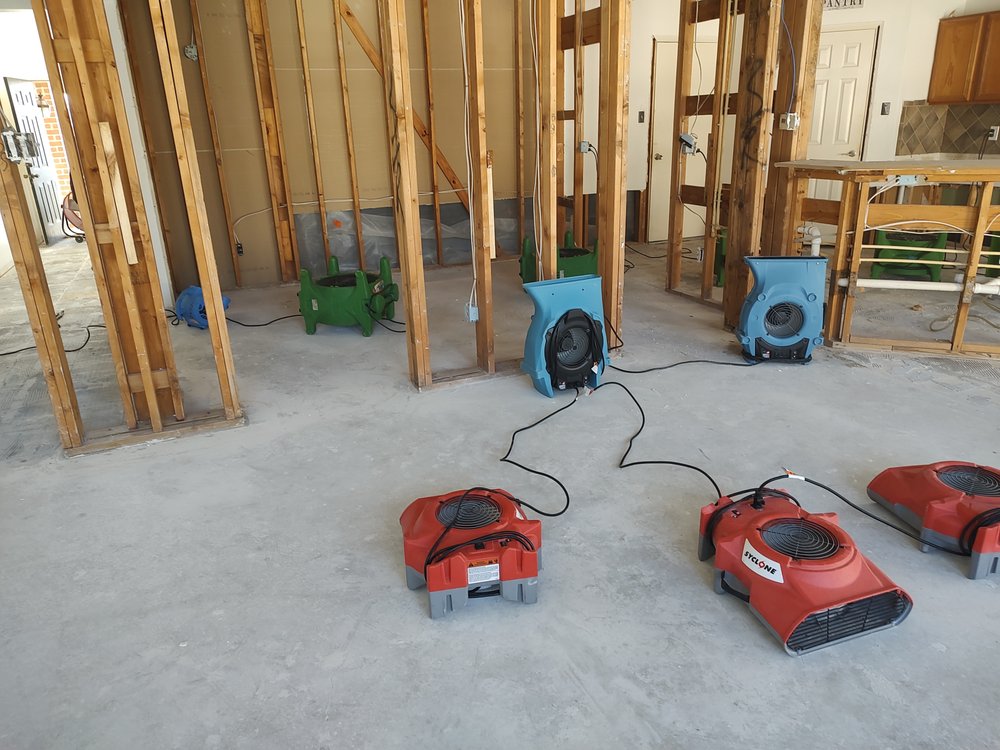
Our structural drying service uses meters, sized equipment and cavity drying to reach the places fans don’t, and records readings until materials meet a dry standard. If standing water is still on the floor, water extraction and removal comes first, because drying can’t make real progress until the bulk water is gone. If you’re right at the start, our guide to what to do in the first 24 hours after water damage puts safety, photos and phone calls in order.
Common questions
How long should I run a dehumidifier after a small leak?
Run it until the wet materials read the same as matching dry materials nearby, not just until the room feels dry. For a small clean-water spill on a hard floor, that is often a day or two. If readings have not moved after 48 hours, the water is probably deeper than a household unit can reach.
Will my insurance still cover the damage if I start drying it myself?
Insurers generally expect you to take reasonable steps to limit further damage, but policies differ. Photograph everything first and ask your insurer before you remove drywall, flooring or cabinets. This is general information, not advice about your specific policy.
Can I rent professional drying equipment?
Many tool rental shops rent carpet extractors, and some rent air movers and larger dehumidifiers. Rented equipment helps with surface water and room humidity. It does not come with moisture mapping or cavity drying, so the same limits on walls and subfloors still apply.
Is it safe to stay home while the house dries?
For a small clean-water leak, usually yes. If the water was sewage or outdoor flood water, or mould is present, keep infants, children, seniors, pregnant people and anyone with asthma away from the area. Leave if there is any electrical or gas concern and follow your utility's guidance.
Published November 2, 2026 by WDR Mississauga. Rebates, bylaws and insurance terms change, so confirm details with the program, your corporation or your insurer before you act.